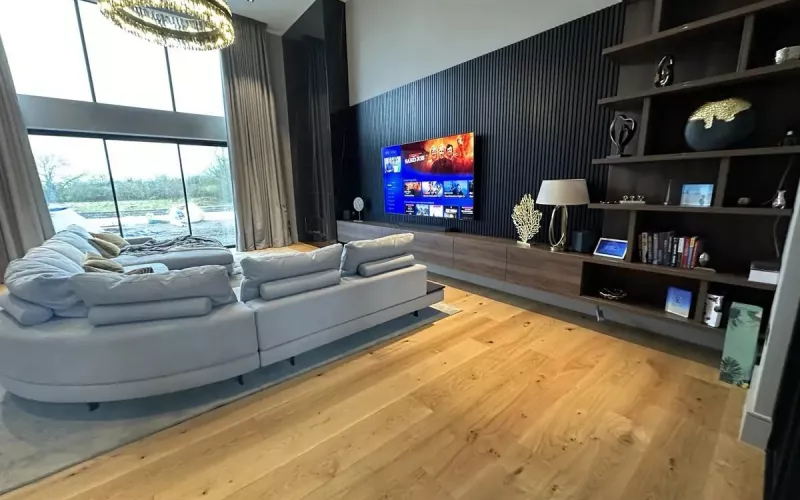
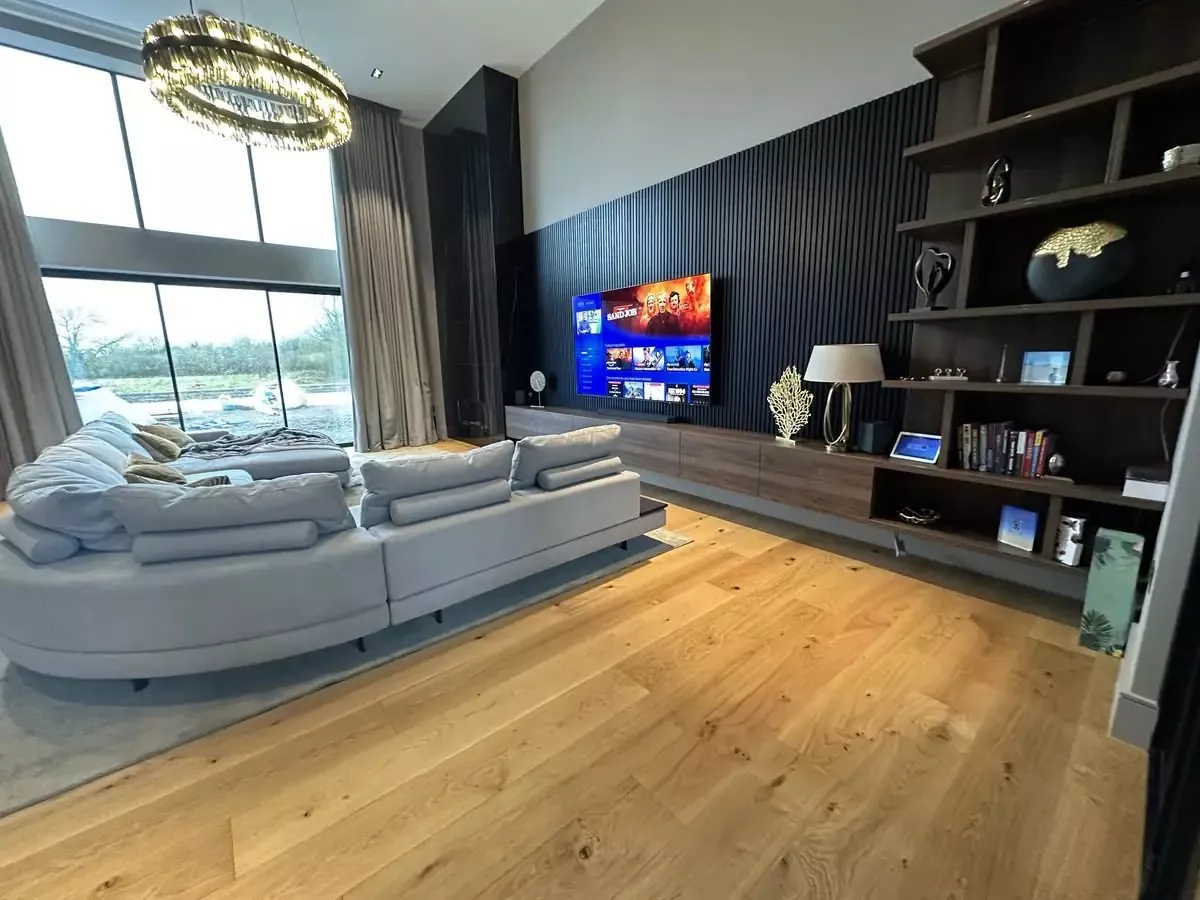
For films, the right TV size puts you at about 1.2 times the screen's diagonal away, so a 65 inch TV wants a seat about 2 metres from the screen and a 75 inch about 2.3 metres. Just as important in a London living room is the height: the top of the screen should never sit more than about 35 degrees above your eyes.
London rooms set awkward problems for a big TV. A Victorian front room has a chimney breast where the TV wants to go, a mansion flat has tall ceilings and deep windows, and a basement or rear extension can be long and narrow. This guide gives a TV size chart in metres, then shows how to fit the screen to the room you actually have.
TV size and seating distance: the numbers
Expert Reviews' guide "What size TV should you buy?" gives a simple formula for cinematic viewing: divide the diagonal size of the screen by 0.84 to get the seating distance. It explains that THX recommends a viewing angle of 40 degrees or less, and that SMPTE suggests 30 degrees or less, which puts you further back. We converted its figures to metres.
| Screen size | Seating distance for films (diagonal divided by 0.84) | Good for |
|---|---|---|
| 43 inch | 1.3 m | Kitchens, studies, small bedrooms |
| 50 inch | 1.5 m | Bedrooms and compact flats |
| 55 inch | 1.7 m | Principal bedrooms and snugs |
| 65 inch | 2.0 m | Most living rooms |
| 75 inch | 2.3 m | Larger living rooms and media rooms |
| 85 inch | 2.6 m | Open plan extensions and basements |
These are the closest you would want to sit for an immersive picture. For everyday television, news and sport, many people prefer to sit a little further back, so treat the figures as the near end of the range rather than a fixed point.
Does 4K change the TV size you need?
Yes. The same guide uses a 50 inch set as its example: a 4K screen has about four times the pixels of a Full HD one, and at under about 1.5 metres the extra detail becomes obvious, while from about 2.4 metres or more you will not see the improvement at all. In practice, that means a 4K screen rewards a bigger size or a closer seat. If your sofa is a long way from the wall, a larger screen does more for the picture than a higher resolution alone.
Mounting height: the part most people get wrong
Expert Reviews quotes the SMPTE finding that viewers become uncomfortable when the top of the screen is 35 degrees above seated eye level. By our own arithmetic, that limit puts the top of the picture no more than about 1.4 metres above your eyes from a seat 2 metres away, or about 2.1 metres above them from 3 metres. Comfortable viewing sits well inside those limits, with the middle of the screen close to eye level.
This is why a TV above a period fireplace so often feels wrong. If the chimney breast is the only wall, we fit a bracket that pulls the screen down and tilts it, or we look for a recess or an alcove instead and leave the fireplace as the feature.
Fitting the TV size to London rooms
- Victorian and Edwardian front rooms. Measure from the bay window seating to the chimney breast. If the alcove beside it is deep enough, a TV in the alcove at eye height is often better than one above the mantel.
- Mansion flats. High ceilings make a TV look smaller than it is. Size by distance, not by how the screen looks against the wall.
- Basements. A dark room with no windows suits a larger screen and is a natural place for a media room. A long basement can take an 85 inch set or a projector.
- Rear extensions and kitchen family rooms. The sofa is often far from the only solid wall. Work out the distance first, then check the light from the glass, which affects the picture more than the size does.
Hide the cables and sort the sound
A large TV looks best floating on a clean wall, which means planning a recessed box, power and a network cable behind it and a route to wherever the equipment lives. Our guide to TV wiring for a London self build covers the cables, and the same thinking applies to a renovation while the walls are open.
The bigger the picture, the more the TV's own speakers disappoint. Our guide to ceiling speakers room by room explains how many a living room needs, and our multi room audio service connects the TV room to the rest of the house. For a room built around the screen, see home cinema installation in London and our cinema room build.
Questions we are often asked
What size TV for a 2.5 metre viewing distance?
Using the 0.84 formula, 2.5 metres suits a screen of about 83 inches for films. A 75 inch set is a comfortable choice if the room is also used for everyday viewing.
Is a 65 inch TV too big for a London flat?
Not if you sit about 2 metres or more from it. Many living rooms, even in flats, have that much space between sofa and wall.
How high should a wall mounted TV be?
Aim for the middle of the screen near seated eye level. Keep the top of the screen well under 35 degrees above your eyes.
Can you put a TV above a fireplace safely?
It can be done, but heat and height both count against it. A pull down bracket helps with the height; check the manufacturer's guidance on heat.
Do you install TVs on their own?
We mount and wire TVs as part of living room, cinema and whole home projects, connected to the sound and control system.
If you are choosing a TV for a London home, we will measure the room, find the best wall and plan the wiring and sound around it.
Book a consultation or call our head office on 01344 937999 (London office 0208 064 0196).
- Log in to post comments