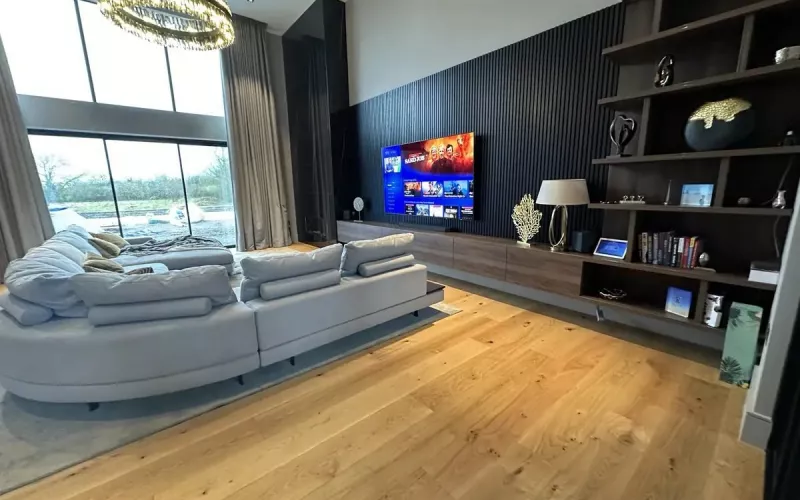
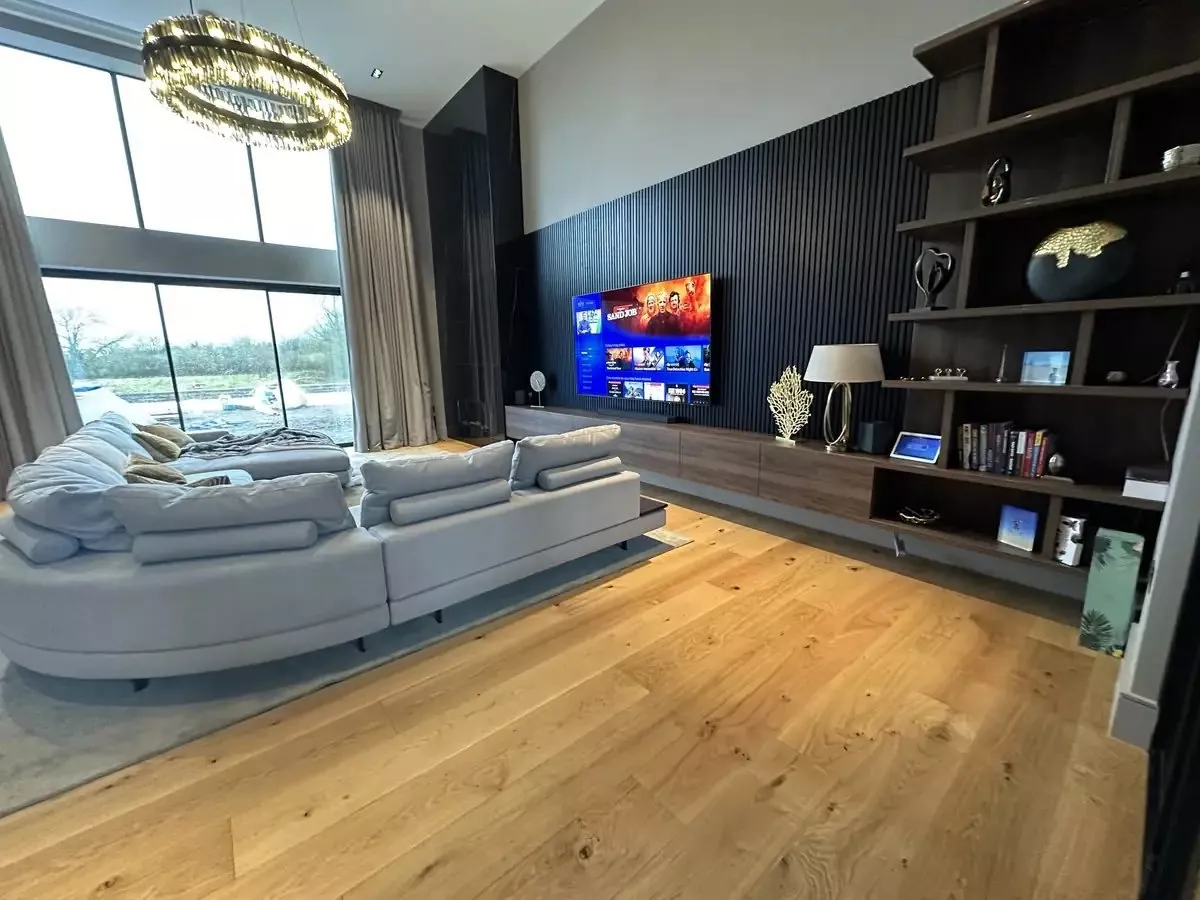
As a rule of thumb, a London room needs one pair of ceiling speakers for every 9 to 14 square metres of floor, so a bedroom takes two, a large kitchen four and an open plan living space six or more. Spacing and position matter as much as the count: speakers placed around the people, not the middle of the ceiling, sound far better.
We plan multi room audio for London flats, townhouses and family houses, and the number of speakers is usually the first thing a client, architect or interior designer asks about. It also has to be settled early, because each speaker needs a cable back to the amplifiers. Here is how we work it out.
How many ceiling speakers: the size rule
The Canadian speaker maker Totem Acoustic puts it simply in its guide How Many In-Ceiling Speakers Do I Need In My Room?: there is no universal answer, but a good rule of thumb is one pair per 100 to 150 square feet. In metric terms that is roughly one pair for every 9 to 14 square metres. Its guide breaks it down like this:
| Room size | Speakers | Typical London rooms |
|---|---|---|
| Under about 14 m² | 2 | Bedrooms, a study, a small kitchen in a flat |
| About 14 to 28 m² | 4 | A through lounge, a principal bedroom suite, a family kitchen |
| Over about 28 m² | 6 or more | A rear extension kitchen and family room, a basement entertaining space |
Totem adds that open plan rooms, vaulted ceilings and odd shaped layouts need more careful thought, and that is where most of our design time goes.
Spacing and distance from walls
The same guide gives two spacing rules that we find useful on London plans:
- Six to ten feet apart. About 1.8 to 3 metres between the speakers in a pair. Too close and the sound overlaps and blurs; too far apart and you get uneven coverage with gaps.
- Away from the walls. At least 2 feet, about 60 centimetres, from the adjacent walls.
For a stereo pair, Totem says to place the speakers an equal distance from the main listening position. For background music through a room, it suggests spreading them evenly across the ceiling so the coverage is uniform.
Flats, townhouses and family houses
The rule of thumb is a start. The building itself usually decides the rest.
Mansion flats and apartments
Ceilings are often concrete, so speakers go into a dropped ceiling or a bulkhead, and the number of positions is limited by what the building allows. Neighbours matter too: speakers with enclosed back boxes help keep the sound in the flat rather than sending it through the ceiling to the flat above.
Georgian and Victorian townhouses
Tall ceilings, cornicing and ceiling roses change the plan. Where an ornate ceiling cannot be cut, we look at the walls, at joinery, or at plaster in speakers that disappear once skimmed. High ceilings also let each speaker cover more of the room, so a pair can often do what would take four in a lower room.
Family houses with rear extensions
The new kitchen and family room is usually the biggest room in the house and the one with the most speakers. We split it into zones, for example the cooking area, the table and the sofa, so each part can play at its own volume.
Room by room in a London home
- Principal bedroom: a pair, placed for the bed. A dressing room or en suite can share the same music with a single speaker.
- Bathrooms: one stereo ceiling speaker, which carries both channels in one unit, is usually enough in a small bathroom.
- Kitchen: two in a galley kitchen, four or more in a family kitchen, placed over the areas you use.
- Living room: a pair for music, set around the seating. If the room has a television, speakers at the screen for dialogue and ceiling speakers for surround usually work best.
- Study: a pair or a single stereo speaker for background music.
- Hall and stairs: one or two, so the music follows you through the house.
- Garden and terrace: weatherproof speakers, covered on our outdoor audio page.
Amplifiers, cables and control
Every pair needs an amplifier channel, and in a multi room system the amplifiers sit in one rack or cupboard, so the speakers are the only thing you see. That means a speaker cable from each position back to the rack, which is simple while the ceilings are open and much harder once they are decorated. If your project is a refurbishment, our guide to smart home wiring for a London renovation lists what else to run at the same time.
We install Sonos, Control4 and Crestron multi room audio, with control from your phone, a keypad or your voice. Smaller systems often suit Sonos; larger houses that want music, lighting and the cinema on one system often suit Control4 or Crestron.
Questions we are often asked
Is two ceiling speakers enough for a living room?
For music in a typical London living room, usually yes, as long as they are placed around the seating. A long or open plan room will need more.
Do bigger ceiling speakers mean fewer speakers?
Sometimes. A larger speaker covers a little more and has more bass, but the spacing rules still apply, so a big room still needs several positions.
Will ceiling speakers disturb the neighbours?
In flats it is a real concern. Enclosed back boxes, sensible volume limits and careful placement away from party walls all help.
Can you add ceiling speakers to a finished house?
Often, especially on the top floor or where there is a void above. Ornate or concrete ceilings are harder, and a survey tells us what is possible.
Can existing speakers be reused?
Often, yes. We test the speakers and cabling already in place and keep what is in good condition when we upgrade the system.
Send us your plans and we will mark up a speaker layout, or see our pages for multi room audio in London and multi room audio in Surrey. For a quick budget, try the Quote Builder.
Book a consultation or call our head office on 01344 937999 (London office 0208 064 0196).
- Log in to post comments