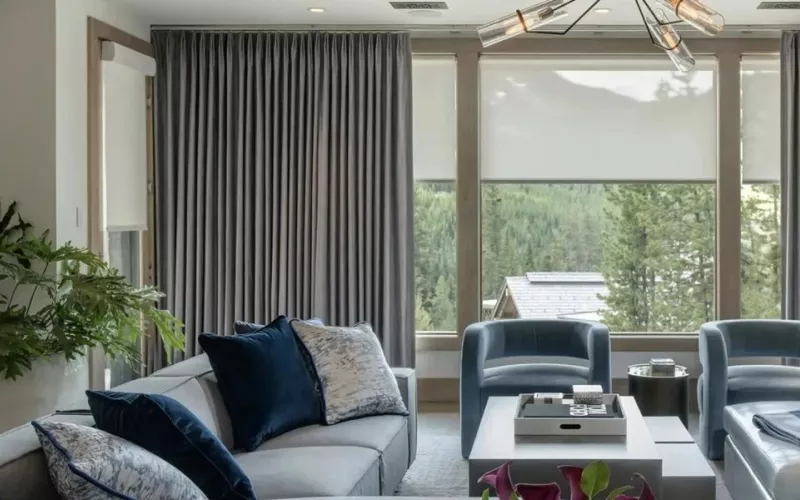
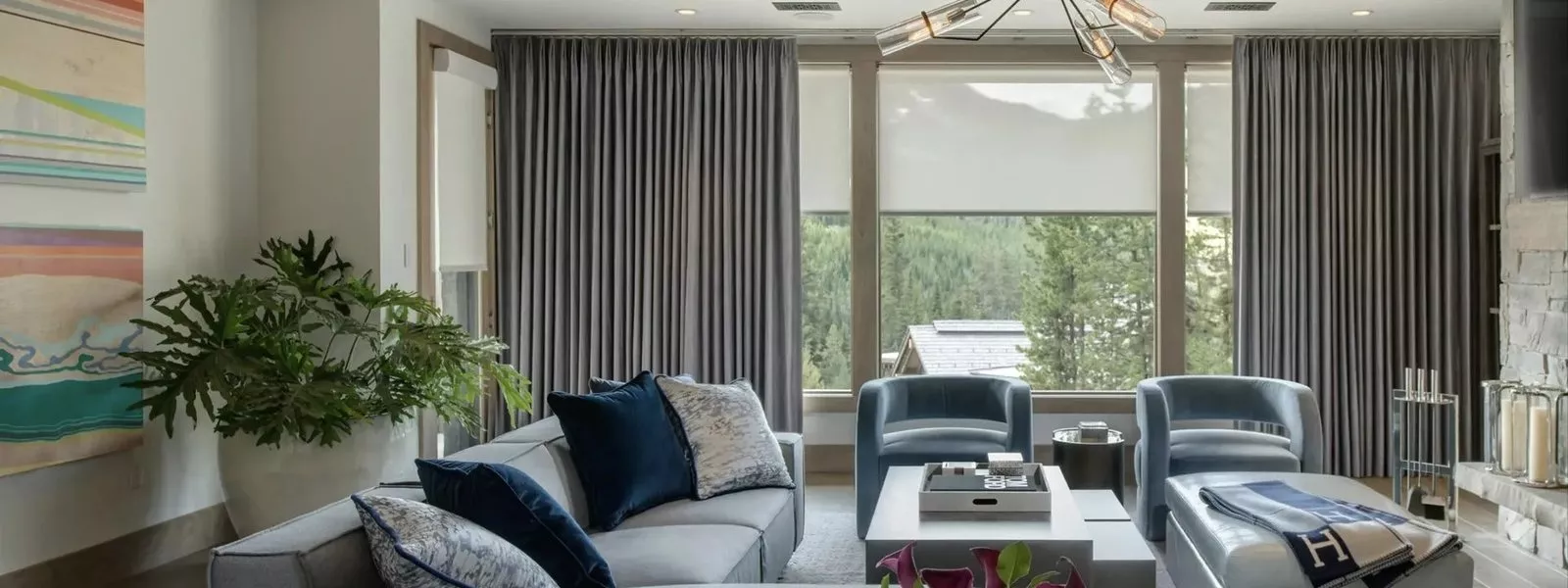
Motorised curtains suit rooms where softness, blackout and sound matter, such as bedrooms, drawing rooms and media rooms; motorised blinds suit rooms where the glass needs to stay clear and the fabric needs to stay out of the way, such as kitchens, bathrooms and garden rooms. In most London homes the answer is a mix, chosen room by room and run from one control system.
We are often asked to quote for "blinds throughout" when a client really wants curtains in half the house, or the other way round. The right choice depends on the window, the room's job and how much stacking space there is either side of the glass. This guide works through the rooms we fit most often in London houses and flats, and explains what to settle before the decorator arrives.
Motorised curtains and blinds: how they differ
A motorised curtain runs on a powered track fixed to the ceiling or the wall above the window. The motor sits at one end of the track and draws the fabric open or closed, either to one side or from the centre. Because the fabric gathers into a stack when open, a curtain needs space beside the window if it is not to cover part of the glass.
A motorised blind rolls, folds or tilts. Roller blinds wind onto a tube hidden in a cassette or a pocket in the ceiling; Roman blinds fold up in soft pleats; venetian blinds tilt their slats. A blind sits within or just over the window opening, so it needs no stacking space at the sides, only a little depth at the head.
Both can be wired to a central supply or run on batteries, and both can be part of the same scenes as the lighting. The decision is about the room, not the technology.
Room by room: where motorised curtains work best
| Room | Our usual choice | Why |
|---|---|---|
| Principal bedroom | Curtains with a blackout lining, often with a sheer or a roller behind | Full blackout, softer acoustics and a hotel feel at bedtime |
| Children's bedrooms | Motorised blinds or curtains with no cords at all | Nothing hanging for small hands to reach |
| Drawing room or formal sitting room | Curtains on a ceiling track | Tall sash windows look finished with full length fabric |
| Family room or snug | Curtains plus a light filtering roller | Glare control by day, privacy and warmth at night |
| Media room or cinema | Blackout curtains or blackout rollers in side channels | Light leaks at the edges spoil a dark picture |
| Kitchen | Roller or Roman blinds | Fabric away from the hob and the sink, easy to clean |
| Bathroom | Roller blinds in a moisture tolerant fabric | Privacy without fabric soaking up steam |
| Rear extension or garden room | Roller blinds, often in a cassette set into the ceiling | Large panes of glass with no wall either side for a curtain stack |
| Rooflights | Dedicated skylight blinds | Out of reach, so motorised is the only practical way |
Bedrooms and the case for curtains
In a bedroom we nearly always suggest motorised curtains with a good blackout lining. A curtain that overlaps the window on both sides and runs up to the ceiling blocks far more light than a blind sitting inside the reveal, and the fabric takes the edge off street noise and echo. Many clients add a sheer or a light filtering roller behind, so they can have daylight and privacy in the morning without opening up to the street.
Motorised curtains also make a morning scene possible: the curtains open slowly at the time you choose, and close at sunset or when you press "bedtime" on the keypad by the bed.
Kitchens, bathrooms and extensions: where blinds win
Kitchens and bathrooms are hard on fabric, and a curtain near a hob is never a good idea. A neat roller or Roman blind is easier to keep clean and stays out of the way.
The glass box at the back of so many London terraces is the clearest case for blinds. Sliding doors and fixed panes often run from wall to wall, which leaves nowhere for a curtain to stack. A roller blind in a slim cassette, or in a pocket formed in the ceiling when the extension is built, disappears completely when it is up. Our guide to motorised blinds for London homes with big glazing covers glare and overheating in these rooms in more detail.
Child safety and corded blinds
Motorised curtains and blinds remove the looped cords and chains that come with many manual blinds. RoSPA's guidance on blind cords says that a looped cord or chain should never be fitted in a child's bedroom, that cords and chains should be checked in every room a child uses, and that corded curtain tracks can pose the same risks. It also points out that millions of blinds fitted before 2014 may not have the safety devices that newer ones include. If you have young children or grandchildren to stay, cordless motorised treatments are the simplest way to take the risk out of the room altogether.
Power, wiring and control
When the walls or ceilings are open, we prefer a wired supply to every curtain track and blind, with a data cable where the system needs one. Wired motors need no charging and respond the same way every time. In a finished, decorated house, battery motors avoid any chasing, though they need recharging from time to time.
Either way, the curtains and blinds can be run from wall keypads, a phone, a touch screen or a timer, and grouped into scenes with the lighting control. A system from Lutron or Rako can run the lights and the window treatments together, so "evening" can dim the lamps and close the curtains in one press. If you are wiring a new build or a full refurbishment, our guide to motorised blinds wiring lists what to run before the plasterers arrive.
What to settle before you order
- Which rooms need full blackout, and which only need privacy or glare control.
- Whether each window has room beside it for a curtain stack.
- Ceiling or wall fixing for the curtain tracks, and whether a pocket or recess can be formed.
- Wired or battery power for each window.
- Fabrics, which your interior designer or curtain maker will usually supply and we will motorise.
- How you want to control them: keypads, scenes, timers or the whole home system.
You can see the range of systems we fit on our motorised blinds and curtains page, and the Surrey blinds page shows how the same approach works in larger country houses.
Questions we are often asked
Are motorised curtains noisy?
Good quality tracks are quiet: a soft hum as the fabric moves, which most people stop noticing after the first week.
Can you motorise my existing curtains?
Often, yes. The fabric usually needs new gliders or a change of heading to suit a powered track, which a curtain maker can do.
Do motorised blinds work if the Wi-Fi goes down?
With a professional control system they keep working from the wall keypads, because the system runs on its own network rather than the broadband.
Should I choose curtains or blinds for a bay window?
Both work. Curved or angled ceiling tracks can follow a bay, and separate blinds can be fitted to each pane; the choice comes down to the look you want.
Can I add more windows later?
Yes. Battery motors can be added at any time, and a wired system can be extended wherever a cable can reach.
If you are planning curtains and blinds for a London home, we will survey the windows, suggest the right treatment for each room and show you how it fits with your lighting and the rest of the house.
Book a consultation or call our head office on 01344 937999 (London office 0208 064 0196).
- Log in to post comments