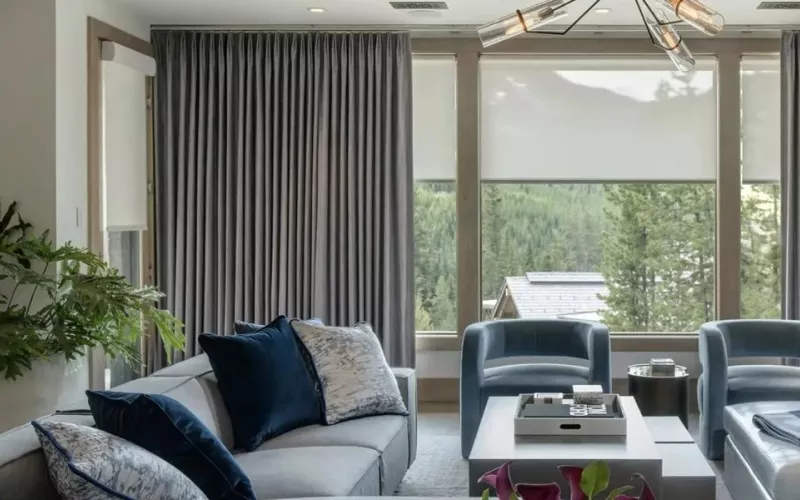
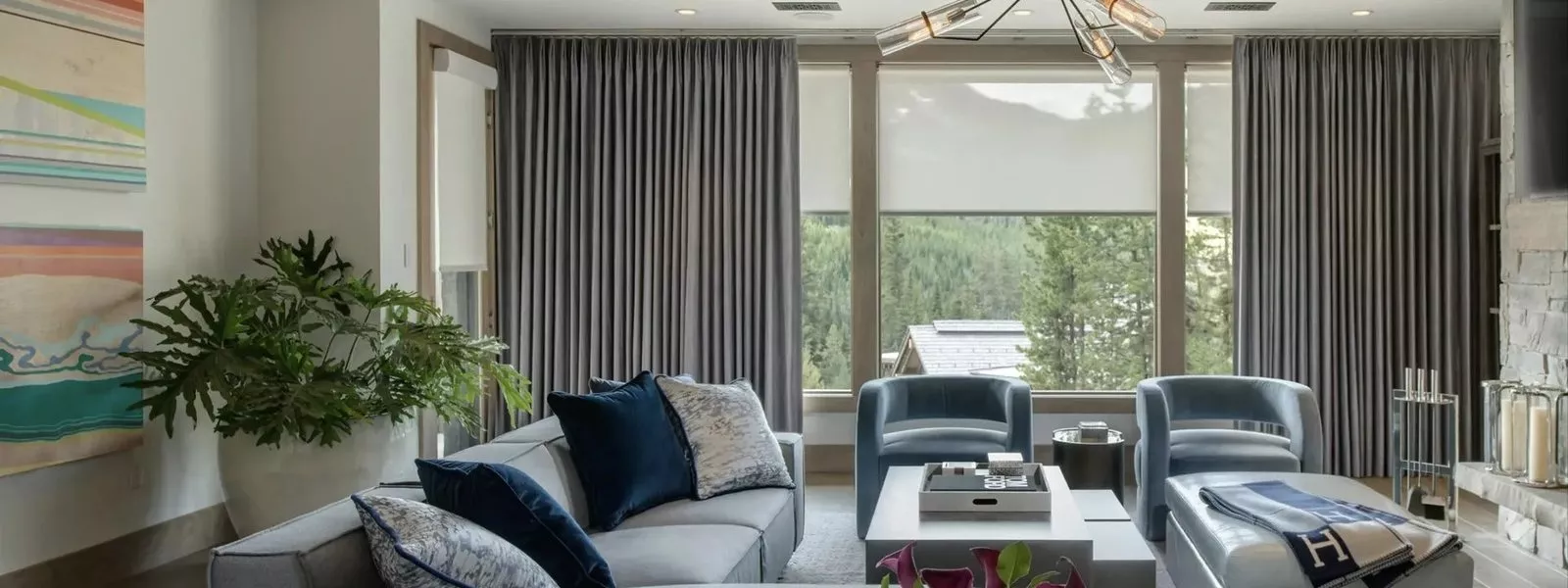
Motorised blinds are the simplest way to live comfortably with big glazing in a London home: they cut glare, give privacy from the flats opposite and keep the worst of the afternoon sun off the room. They do not replace external shading or ventilation for overheating, but because they move on a schedule they are used every day, which is when they help most.
Floor to ceiling windows sell London flats and extensions. They also bring three problems that buyers find out about in the first summer: screens you cannot see, neighbours who can see you, and rooms that heat up by mid afternoon and stay warm into the night. This guide explains what blinds can do about each, what the building regulations say, and how to plan blinds that look after themselves.
Why London homes with big glazing get hot
Dense, built up parts of a city hold on to heat, and the building regulations recognise this. Approved Document O, which covers overheating in new residential buildings in England, treats urban and some suburban parts of London as a high risk location, listed by postcode in its Appendix C. Under the document's simplified method, new homes in that location need shading, with options such as external shutters with means of ventilation, or glass with a g-value of no more than 0.4.
Approved Document O lists shutters, external blinds, overhangs and awnings as fixed shading devices. It also says that internal blinds and curtains do provide some reduction in solar gains, but that they should not be taken into account when checking whether a new home meets the requirement. So internal motorised blinds are not a way to pass Part O. They are a way to live well in the home once it is built, and for most existing flats and extensions they are the shading you can actually add.
The night time problem
Approved Document O also expects designers to consider that bedroom windows are likely to be closed between 11pm and 7am where outside noise is high, and to count only the openings that can be opened securely. In a London flat on a busy road, that means the room has to stay cool without relying on an open window at night, which makes keeping the sun out during the day all the more important.
What motorised blinds do for each problem
| Problem | Typical London setting | Motorised blinds that help |
|---|---|---|
| Glare | Open plan living and kitchen with a glazed rear wall; a study in the eaves | Solar screen fabric that keeps the view and cuts the brightness |
| Overlooking | Flats facing flats across a street or courtyard; ground floor rooms on the pavement | Sheer or screen fabric by day, closing fully at dusk |
| Afternoon heat | West facing living rooms, penthouses, glazed roofs in rear extensions | Blinds that lower on a schedule before the sun reaches the glass |
| Short summer nights | Bedrooms, especially facing east or under a roof light | Blackout fabric that closes at bedtime and opens gently at a set time |
| Fading | Timber floors, rugs and art in sunny rooms | Blinds that close while the room is empty |
Why automation matters more than the fabric
The best blind in the world does nothing for heat if it is left open while everyone is out at work. That is the problem with manual blinds in a sunny room: they are lowered after the room is already hot. Motorised blinds can close by schedule, by scene or when a room gets too warm, so the west facing windows are covered at two o'clock whether anyone is home or not.
Useful scenes include an afternoon scene that lowers the west and south blinds to a set height, an away scene that closes everything at dusk so the home looks occupied, and a morning scene that opens the bedroom blinds slowly. Blinds can sit on the same keypads as your lighting control, so one button sets both.
Planning motorised blinds for a London flat or extension
Existing flats and houses
Battery and wireless motors mean most existing windows can be automated without new cabling, which matters in mansion flats, listed buildings and homes where the walls must not be disturbed. Brackets are chosen to suit the frames and reveals.
Extensions and new builds
Where the ceilings are open, plan a recess or pocket above each window so the blind disappears when it is up, and run power or a control cable to it. Our guide to motorised blinds wiring covers what to put in before the plasterers arrive. For a glazed roof or a tall gable, motors are the only practical way to use a blind at all.
External shading
If the design of a new home includes external blinds or shutters, that is a decision for your architect at design stage. Inside the glass, we deal with glare, privacy and the comfort of each room.
What we install
We install Lutron and Crestron roller blinds, curtains, Roman blinds and shades, with blackout fabrics for bedrooms and cinemas and solar screens for living areas, controlled by keypad, app, voice, schedule or scene. See our motorised blinds in London page and our blinds and curtains page for the range, or our Lutron page for that system in particular. Crestron's newer sheer shades are covered in our post on Crestron horizontal sheer shades.
Blinds can be part of a whole house system with lighting, heating and audio; our home automation in London page explains how it fits together. We also cover Surrey and the counties around London.
Questions we are often asked
Do motorised blinds count towards Part O?
No. Approved Document O says internal blinds and curtains should not be taken into account when checking compliance, even though they reduce solar gains. They help with comfort in the finished home.
Does Part O apply to my extension?
Approved Document O applies to new residential buildings. The government's frequently asked questions say it does not apply to extensions added to a home after it is built, but blinds are still worth planning for a sunny extension.
Can blinds close automatically when it is sunny?
Yes. They can follow a schedule, a scene, or close when a room gets too warm, so they work while you are out.
Can you motorise blinds in a rented or listed flat?
Often, yes. Battery and wireless motors need no new cabling, and fixings are chosen with the building in mind. Check with your landlord or managing agent first.
Are motorised blinds noisy?
No. The Lutron and Crestron motors we fit are some of the quietest you can buy, and they are made for use in bedrooms.
If your London home is bright and beautiful but too hot or too exposed, we will look at each window with you and plan motorised blinds that do their job every day.
Book a consultation or call our head office on 01344 937999 (London office 0208 064 0196).
- Log in to post comments