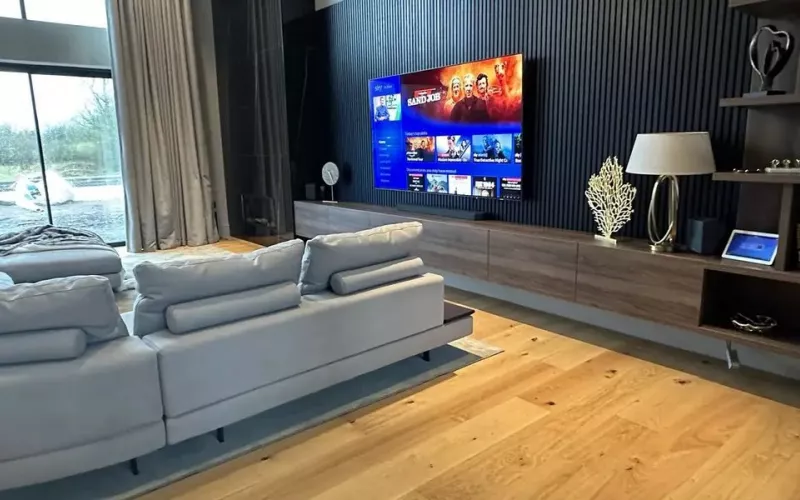
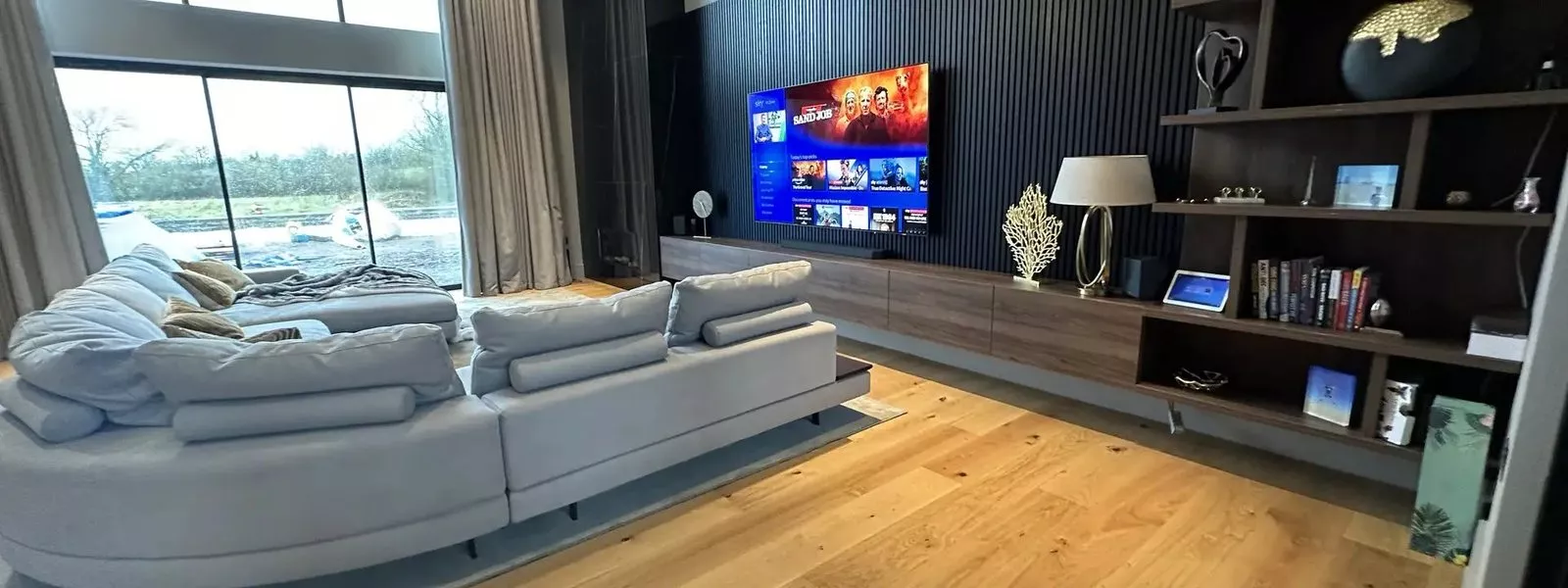
You do not need a dedicated cinema room to enjoy Dolby Atmos at home: two or four height speakers added to a good surround system in a London living room will give you sound from above. The ceiling, the furniture and how much building work you are willing to do decide whether those speakers go into the ceiling, onto it, or on top of the front speakers.
Most of the people who ask us about Dolby Atmos are not planning a basement cinema. They want the main living room, the one with the big TV and the sofa, to sound like the films and series they stream. That is a reasonable goal, and in most London homes it is achievable. This guide explains what Atmos needs, where height speakers go in a normal living room, and how period ceilings, flats and family life change the plan.
What Dolby Atmos adds
A conventional surround system places sound around you at ear level: front left, centre and right, plus surround speakers to the sides or behind. Dolby Atmos adds a layer above. Rain, aircraft, music in a large hall and the hum of a busy street can come from overhead as well as around, and the effect is a room that feels larger and more natural.
Speaker layouts are written as three numbers. A 5.1.2 system has five speakers at ear level, one subwoofer and two height speakers. A 5.1.4 system has four height speakers, and a 7.1.4 system adds two more at ear level. Dolby's Dolby Atmos Home Theater Installation Guidelines describe five speakers on the floor and two producing overhead sound as the starting point, and say that speakers other than the centre and centre surround must be added in pairs.
Three ways to add Dolby Atmos height speakers
In ceiling speakers
Round speakers cut into the ceiling are the neatest answer and the one we use most. Once painted they almost disappear. Dolby's guidelines favour overhead speakers with a wide dispersion pattern, and say speakers with that pattern can face straight down. In a living room that usually means two speakers slightly in front of the sofa, or four in two pairs, one in front of the seats and one behind.
Speakers mounted on the ceiling or high on the wall
Where you cannot cut into the ceiling, small speakers can be fixed to it or high on the wall and angled towards the seats. Dolby's guidelines say on ceiling speakers should be at least twice the height of the listener's ear level, which in a London room with a decent ceiling height is easy to achieve.
Upward firing Dolby Atmos enabled speakers
These sit on top of the front speakers, or are built into them, and bounce sound off the ceiling. They need no cutting at all. Dolby is clear about the conditions: the ceiling should be flat, not angled or vaulted, ideally between 2.3 and 3.66 metres high, and made of a reflective material such as plaster or plasterboard. Dolby recommends four of them where possible, and says that if you only use two they belong at the front left and right.
Choosing the right option for your room
| Your room | What usually works | Why |
|---|---|---|
| Ceiling being replaced or skimmed as part of a renovation | Four in ceiling speakers | Cables and cut outs are simple while the ceiling is open |
| Victorian or Edwardian room with cornice and a ceiling rose you want to keep | Two in ceiling speakers placed clear of the plasterwork, or upward firing speakers | Protects the original features |
| Flat with a concrete ceiling | Upward firing speakers or on wall height speakers | Cutting into a concrete slab is rarely allowed or sensible |
| Loft room or room with a sloping ceiling | In ceiling or on wall speakers aimed at the seats | Bounced sound does not work well off an angled surface |
| Rented home | A soundbar with upward firing drivers | No changes to the building |
Dolby Atmos and the London home
London living rooms bring their own questions. A Victorian terrace often has lath and plaster ceilings, with joists that run front to back and sometimes a cornice worth keeping. We survey the ceiling first, find the joists and services, and place the speakers where they look deliberate rather than squeezed in. Where the original plasterwork matters, we will say so and plan around it.
In a mansion block or a modern flat, the ceiling above you is often concrete, and the building may have rules about what you can fix to it. Upward firing speakers or a pair of discreet wall speakers set high are usually the answer there. Flats also mean neighbours. Atmos adds sound above you, which is also sound heading towards the flat upstairs, so we keep the subwoofer off shared walls where we can and set the system up at a sensible level.
Open plan rooms in rear extensions are a different challenge. The sofa may face a TV wall with a kitchen behind it and a glazed roof overhead. A glass roof is no surface to bounce sound from, so height speakers go into the solid part of the ceiling instead. If you are also planning music in the kitchen, our guide to ceiling speakers room by room in a London home shows how the two systems can share a ceiling without clashing.
The rest of the Dolby Atmos system
Height speakers are only one part. To hear Dolby Atmos you also need a source that carries it, such as a streaming service, a games console or a Blu ray player, and an AV receiver or processor that decodes it and drives every speaker. The TV and the receiver are connected by HDMI, and the receiver needs enough channels for the layout you choose. A 5.1.2 system needs at least seven channels of amplification, a 5.1.4 system nine.
We often put the receiver in a cupboard or an equipment rack rather than under the TV, which keeps the room tidy and lets one remote or a Control4 or Crestron system turn everything on with one press. The same system can dim the lights and close the curtains when the film starts.
Wiring for height speakers in a renovation
If the room is being renovated, run the speaker cables now even if you are not buying the speakers yet. A cable to each likely height position, back to the TV wall or the equipment cupboard, costs very little while the ceiling is down. Our guide to smart home wiring for a London renovation lists what else to run at the same stage, from data points to blinds.
When a cinema room still makes sense
A living room system is a compromise between sound, looks and family life. If you want a dark room, a projector, tiered seats and seven or more speakers at ear level, a dedicated room in the basement or a garden building is the better route. Our home cinema installation in London page explains how we plan those rooms, and the Finchampstead home cinema shows a complete build. For music throughout the rest of the house, see multi room audio in London.
Questions we are often asked
Can a soundbar give me real Dolby Atmos?
A good soundbar with upward firing drivers gives a convincing sense of height in a smaller room. Separate height speakers in or on the ceiling give a clearer, more precise effect, especially in a larger room.
How many height speakers do I need for Dolby Atmos?
Two is the minimum and works well in a typical living room. Four gives a more even effect across a wider sofa or a larger room.
Will ceiling speakers damage a period ceiling?
Not if they are planned properly. We find the joists first and keep clear of cornices and ceiling roses. Where a ceiling is too fragile or important to cut, we use another option.
Can the same ceiling speakers play music?
Yes. The height speakers are ordinary speakers, so with the right system they can also play music when the TV is off.
Do I need a new TV for Dolby Atmos?
Not always. Many recent TVs pass Atmos to a receiver over HDMI. We check your TV and sources before recommending anything.
If you would like Dolby Atmos in your London living room without giving up the room to a cinema, we will look at the ceiling, the layout and the way you use the space, and design a system that fits.
Book a consultation or call our head office on 01344 937999 (London office 0208 064 0196).
- Log in to post comments