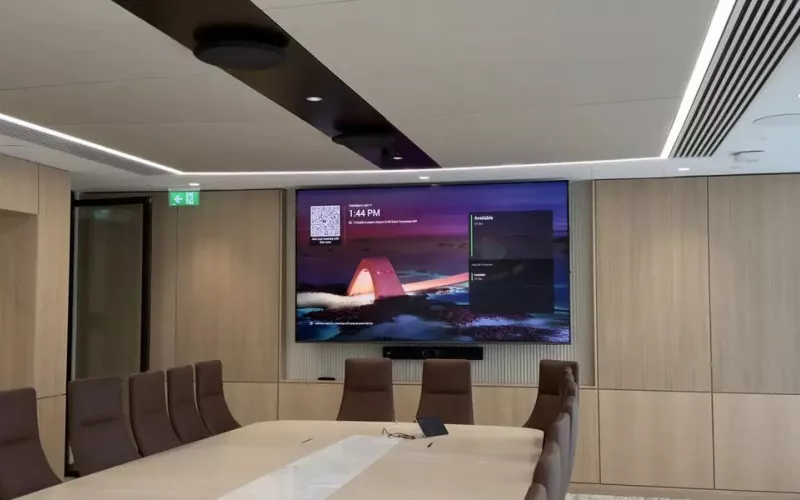
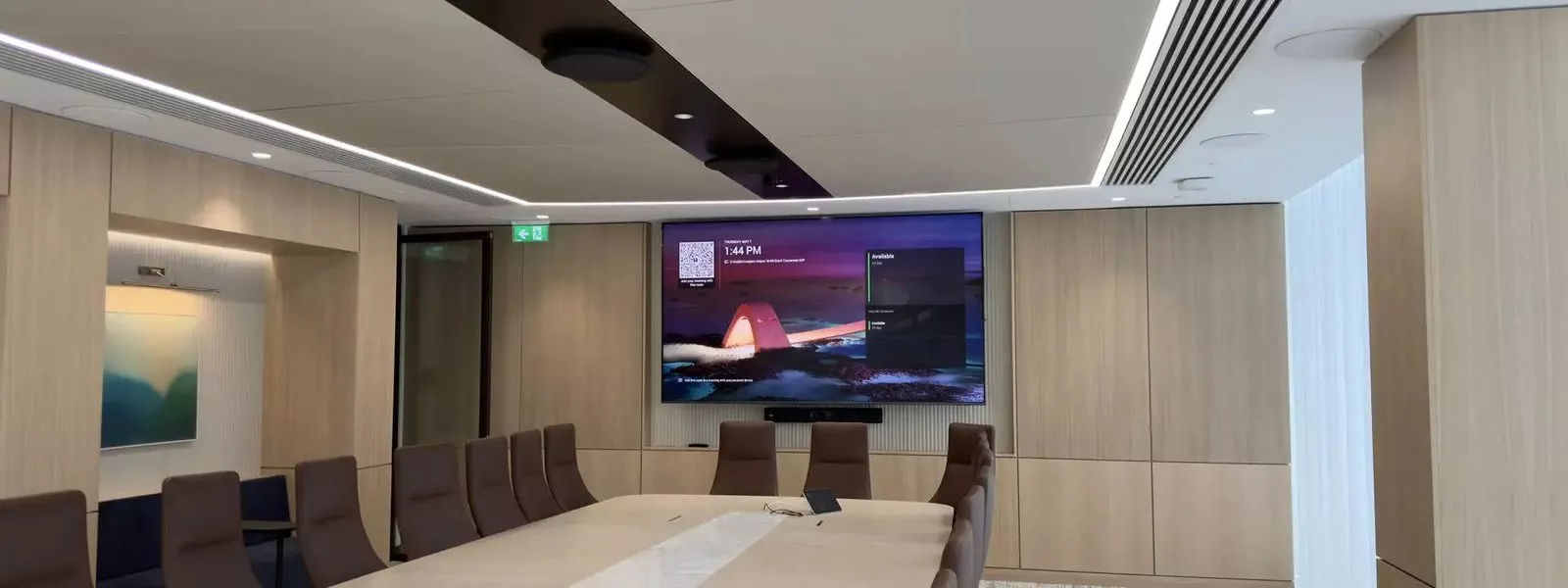
Crestron's guide to practical AI for meeting rooms, published on 18 September 2026, makes one point every London office should hear before it pays for another AI licence: none of it works unless the cameras, microphones and speakers in the room are good enough. This post sets out what Crestron said, which AI features are worth having, and what each one needs from the room.
What Crestron said about AI for meeting rooms
On 18 September 2026 Crestron published Practical AI for AV Systems: The Hype vs. The Hardware, the first of three articles written to help its dealers talk plainly to clients about AI. It is not a product launch. It is a way of sorting the useful from the noise, and it is frank for a manufacturer.
The central line comes from Joel Mulpeter, Crestron's senior director of product marketing: "None of it works if the hardware feeding it is insufficient." The article treats AI as a category of software that does specific jobs well, such as voice recognition, face tracking and room measurement, and says it is no replacement for engineering judgement.
The trade press picked up a similar theme at CEDIA Expo 2026 earlier that month. CE Pro's report on the show, published on 10 September 2026, said that "AI is quietly becoming installation infrastructure rather than a gimmick." That report is about the smart home trade, but we think the point carries over to the office: AI is now part of how a room is designed, not something added at the end.
Embedded AI and connected AI: the two kinds
Crestron sorts the AI in a room into two kinds. Mr Mulpeter is careful to say the labels mix industry terms with language Crestron uses internally, so you may not hear them from every manufacturer.
- Embedded AI is intelligence built into a product. In Crestron's description it works as soon as the product is powered on, with no setup and no integration.
- Connected AI is what Crestron calls the open layer: the programming interfaces, drivers and other tools that let outside AI services plug into a space. The article names Microsoft Copilot and Zoom AI Companion as examples.
The split is useful when you are budgeting. Embedded AI comes with the equipment you choose. Connected AI typically arrives through the meeting platform your company already uses, so the room's job is to feed it clean sound and clear pictures.
What each AI feature needs from the room
Crestron's article gives three examples of AI features that depend on the equipment underneath. The first two columns below are Crestron's argument. The third is our own advice as installers.
| AI feature | What Crestron says it depends on | What we would check in the room |
|---|---|---|
| Speaker attribution, so a transcript shows who said what | Microphones and audio processing that can isolate voices | Enough microphones for the length of the table, not one bar at the far end of a long room |
| Camera framing of the person presenting | A camera sensor and processing that can track motion cleanly | Where the camera sits, the light on people's faces and a clear view of every seat |
| Meeting summaries | The audio: Crestron says summaries are only as good as the sound they are built from | Echo from glass walls and hard tables, air conditioning noise and where the microphones are placed |
Crestron sums up the dependencies as signal quality, measurement accuracy and fast processing. Put simply, an AI assistant hears what a remote colleague hears. If people on the far end of your calls ask you to repeat yourself, the assistant is working from the same poor sound.
Who this is for
- Offices rolling out AI assistants. If your company has bought, or is about to buy, AI features for its meeting platform, the rooms decide whether the transcripts and summaries are worth reading.
- Offices planning a fit out or refurbishment. Microphone positions, camera sight lines and acoustic treatment are far cheaper to settle on the drawings than after the ceilings are closed.
- Teams with rooms that already disappoint. A long boardroom with a single video bar, or a glass walled room with a hard table, will not be rescued by software.
What you need to get it: the hardware behind the argument
Beside the article Crestron features three product families: Automate VX, DM NAX Intelligent Audio and Crestron Intelligent Video. Its announcements from the start of 2026 show the kind of hardware it has in mind.
- DM NAX Intelligent Audio. Announced on 2 February 2026 as a networked audio platform for huddle, medium and large rooms, built from microphones, speaker pods and network powered speakers with the DM NAX AP-100 processor. Crestron lists echo cancellation, automatic gain control, noise reduction and automatic mixing, and says the audio is tuned so that assistants such as Microsoft Copilot capture speech accurately.
- The 1 Beyond i12D camera. Announced in the same release: a single camera with three 4K lenses, automatic group framing and speaker tracking. Crestron says it is certified for Microsoft Teams Rooms and Zoom Rooms.
- Automate VX. Crestron's multi camera system, which switches between cameras according to who is speaking. On 27 January 2026 Crestron announced AutoMeasure for it, a feature that uses computer vision to measure where the cameras and microphones have been installed, in place of measuring by hand.
- Collab Compute. The room computer Crestron announced on 20 January 2026, built on an Intel Core Ultra processor with a neural processing unit. Crestron's release says features such as auto framing, speaker identification and real time transcription depend on sustained local processing.
Crestron's announcements give no prices, and availability changes, so ask us what can be supplied for your project. Crestron is also not the only route. Our Microsoft Teams Room installations in London also use Neat, Logitech and Yealink equipment, and the same hardware test applies whichever brand is on the wall.
What it means for your London office
Our advice is to start with the room, not the licence.
- Write down what you want AI to do. Notes after every meeting, a transcript with names, a camera that follows the presenter: each one asks something different of the room.
- Listen to the room as it is. Join a call from outside the building and have colleagues speak from every seat. What you hear is what the AI hears.
- Fix the sound first. Microphones, speakers and acoustics do the most for transcripts and summaries.
- Then the camera. Position and lighting matter as much as the model.
- Then the computer and the platform. Choose the room system and licences once the room can feed them properly.
As a Crestron installer and one of the AV installers in London that designs, fits and supports its own rooms, we cover this at the survey and design stage of our process. Two of our recent posts show the choices in real rooms: a boardroom audio system with microphones along the table, and meeting room technology across one office. For Crestron's other workplace news, see our posts on the 15 inch TSW-1580 touch screen and DM NVX Multiview for business. To put rough numbers on a room, try the meeting room quote builder.
Questions we are often asked
Does a meeting room need new hardware to use Microsoft Copilot?
Not always: in Crestron's terms Copilot is connected AI that plugs into the space as an outside service, but its results depend on the sound and pictures the room sends it, so a room with poor audio is the first thing to fix.
What is the difference between embedded AI and connected AI?
Embedded AI is built into a product and works when it is switched on, while connected AI is the open layer that lets outside services such as Microsoft Copilot or Zoom AI Companion plug into the room.
Is Crestron's article announcing a new product?
No. It is the first of three articles on explaining AI to clients, and the products Crestron features beside it are already in its range.
Which matters more for AI, the camera or the microphones?
In our view the microphones, because transcripts, speaker names and summaries all start with the audio, and Crestron makes the same point about summaries.
Is AI in a meeting room always right?
No. In Crestron's article Mr Mulpeter says "Machine learning is deterministic in its outcomes, while AI is probabilistic", and he adds that AI reasoning may take a different path and, in some cases, reach a different outcome, so a summary should be read before it is relied on.
Book a consultation or call our head office on 01344 937999 (London office 0208 064 0196).
- Log in to post comments