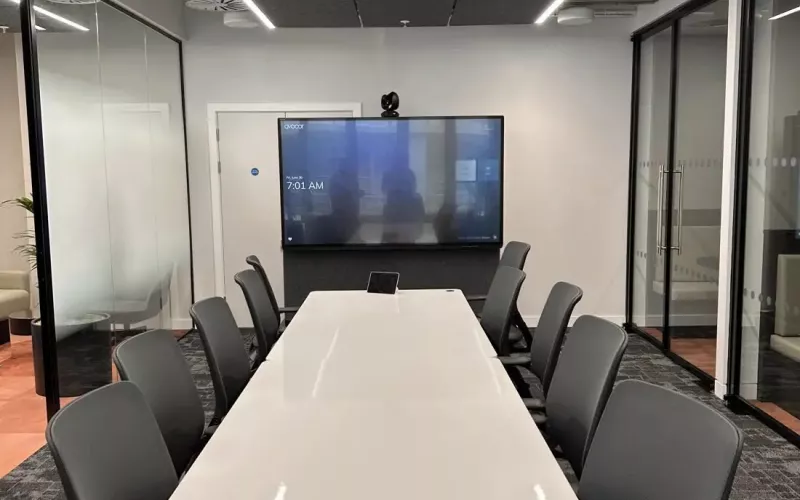
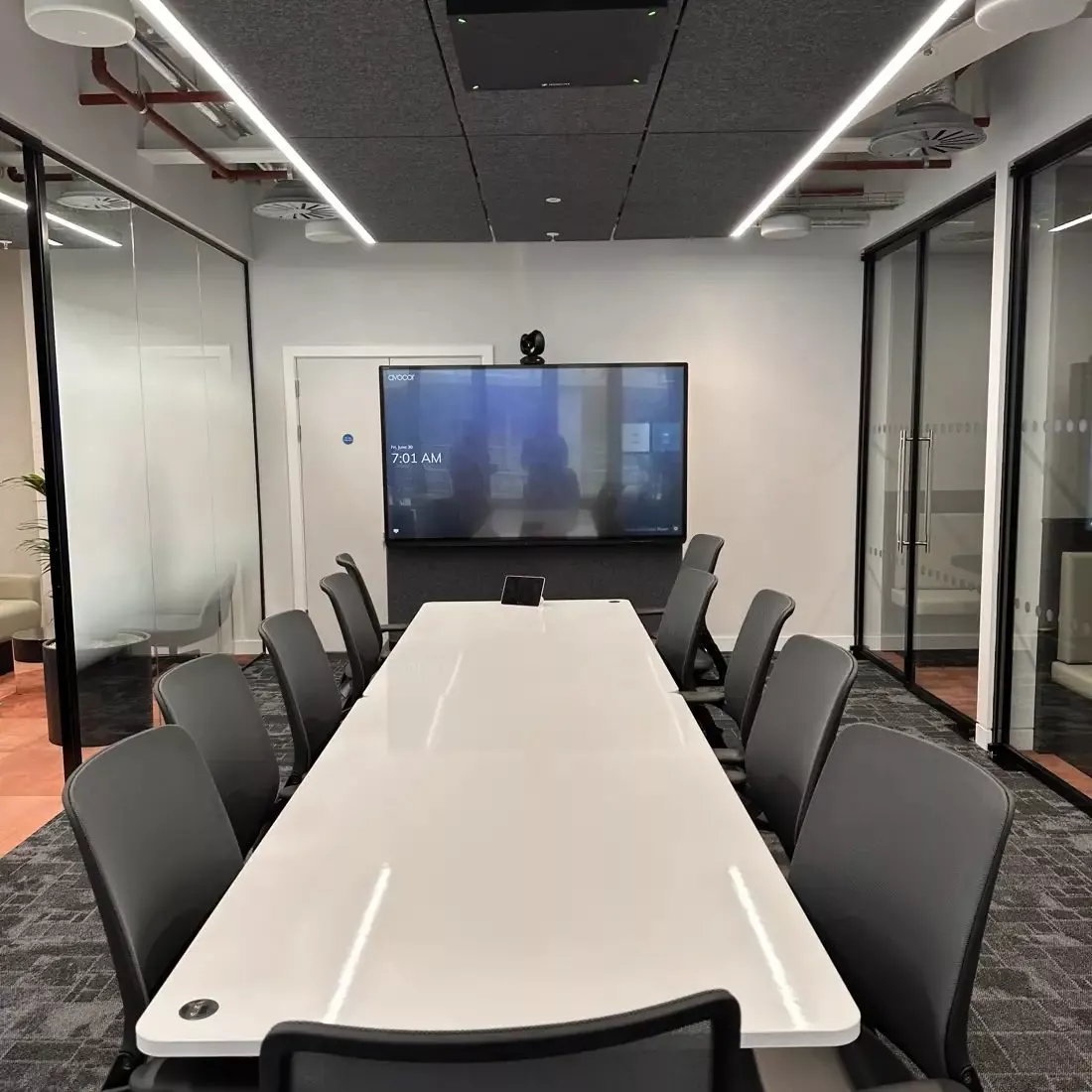
Commercial AV break fix gives a London business a fixed, agreed response whenever meeting room or display equipment fails, without paying for round the clock monitoring. The cover worth buying sets a response level for each site before anything breaks, logs every fault as a single ticket, and leaves a written record of what was repaired and which firmware was running.
In a London office the cost of a failed room is easy to see: a client pitch moved to a corner of the open plan floor, a board call taken on a laptop, a hotel conference suite apologising to delegates. The question is never which manufacturer made the screen. It is who is coming, and how soon. This guide sets out how to judge break fix cover before you need it.
Break fix or managed service?
The two are often confused. A managed service watches your systems continuously and charges for that attention every month. Commercial AV break fix is simpler: when something fails, you report it and an engineer attends within the agreed time to repair it. For many businesses, especially those with reliable equipment and an in house facilities team, break fix is the better value, with planned visits added only for the rooms that matter most.
Typical equipment covered includes:
- Wall displays and interactive displays
- Video conferencing systems and Teams Rooms in London offices
- Ceiling microphones, speakers and audio processors
- Touch panels, room booking screens and control processors
- Digital signage and LED walls in receptions and shop fronts
- The switches and cabling the AV relies on
How to judge commercial AV break fix cover
Five questions separate good cover from a phone number on a sticker:
| Question to ask | The answer you want |
|---|---|
| How fast will you attend? | Next business day for most faults, next business day plus one for low priority work, and a booked slot where building access must be arranged |
| How is each fault recorded? | One ticket per call out, showing the site, the equipment, the brand and the type of fault |
| What do I get after the visit? | A note of the repair, with the firmware version before and after |
| What if the repair costs more than expected? | Nothing outside the agreed scope goes ahead without your written approval |
| How is time charged? | From arrival on site, with travel listed on its own line |
London buildings bring their own problems
Response times in London are shaped as much by buildings as by traffic. Managed office blocks often need contractors booked in with the landlord, with insurance documents checked at the desk. Some floors are only reachable with an escort. Hotel function rooms are booked solid, so a repair may have to happen at seven in the morning. Good break fix cover plans for this: the access details for each site are recorded once, and a pre booked slot is used where turning up unannounced would waste the visit.
Why the written record matters
A short repair note feels like admin until the same fault returns. Then it is the difference between a quick fix and starting from scratch. The AVIXA performance verification standard gives a framework for deciding which parts of an AV system need checking, when, and against what criteria. Applying the same habit to support, with every repair and firmware change recorded, is what lets the next engineer arrive with answers.
Every ticket sits in the client portal, so your team can see the history of any room without chasing emails.
Signs your current cover is not working
Many London businesses already have some form of AV support, often inherited from the installer who fitted the rooms years ago. It is worth a second look if any of these sound familiar:
- Nobody can say how long the last three repairs took to arrange.
- Faults are reported by email to one person, and the history leaves with them.
- The same room fails every few weeks and each visit starts from the beginning.
- Invoices arrive with a single figure and no breakdown of time on site and travel.
- Extra work appears on a bill without anyone having agreed to it first.
Agree what sits outside the cover
Clear cover is as much about what is excluded as what is included. Before signing, agree how you want to handle new installations, room moves, damage and replacement equipment. None of these needs to be a surprise: the rule is simply that anything outside the agreed scope is priced and approved in writing first, so the facilities team stays in control of the budget.
Getting cover in place
- List the rooms and the equipment in each, with brands and models.
- Agree a response level per site, and mark the rooms that come first.
- Record access arrangements, opening hours and loading or parking details.
- Name the people who can approve extra work.
For the rooms that cannot fail, planned checks through 1Install Care can sit alongside break fix, and our AV installers in London handle any upgrade the support history points to.
Questions we are often asked
Is commercial AV break fix cheaper than a managed service?
Usually, because you pay for attendance when something fails rather than for continuous monitoring. The right choice depends on how critical each room is.
Can different sites have different response levels?
Yes. Each site is agreed separately, so a head office and a small branch can be covered differently.
How do we log a fault?
Through the client portal or the contact form. A ticket is created straight away with the site and equipment.
Do you work out of hours?
Visits can be pre booked early or late where a room is in use during the day, agreed per site.
Will we be charged for travel?
Travel is shown on its own line, separate from time on site, so every invoice is clear.
To arrange commercial AV break fix for your London sites, Book a consultation or call our head office on 01344 937999 (London office 0208 064 0196).
- Log in to post comments