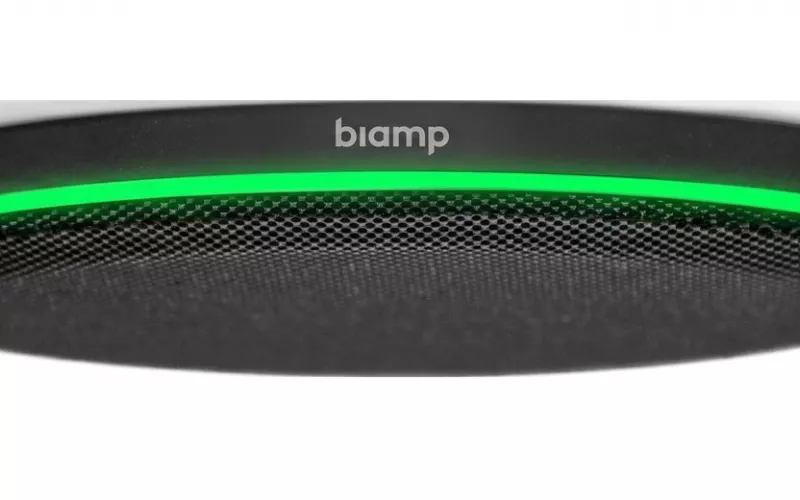
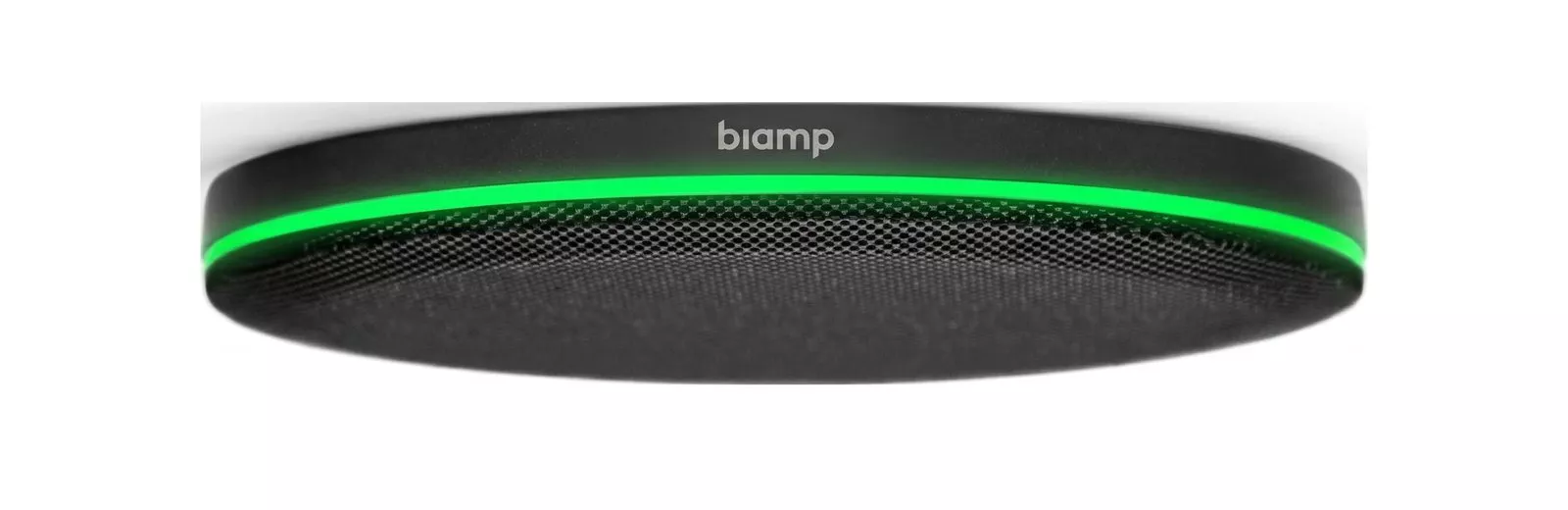
On 29 September 2026 Biamp announced that Emory College of Arts and Sciences in Atlanta, Georgia has piloted Biamp voice reinforcement using Parlé Voice Lift, running on Parlé TCM Beamtracking ceiling microphones and TesiraFORTÉ X processors it already owned. It matters for London universities, colleges and schools because the approach lifts a lecturer's voice with no handheld or wearable microphones at all, which removes the batteries and charging docks that, according to Biamp, had held Emory back from traditional voice lift.
Product image: Biamp.
- Biamp announced the Emory College of Arts and Sciences project in a press release dated 29 September 2026.
- The system is Parlé Voice Lift, built on existing Parlé TCM Beamtracking ceiling microphones and TesiraFORTÉ X processors; Biamp says the campus systems include TesiraFORTÉ X 400 and X 800 units.
- The pilot ran in the college's Anthropology Room 303 and, according to Biamp, needed no new microphone infrastructure.
- Biamp says around 140 learning spaces on the campus already use Biamp systems, with roughly 300 Parlé TCM Beamtracking ceiling microphones in place.
- Biamp's product page states that Tesira 5.6 or later is required to enable Parlé Voice Lift.
- For London, the story is most relevant to universities, colleges, schools and training providers with lecture theatres and large teaching rooms.
What Biamp announced on 29 September 2026
In its press release on the Emory College of Arts and Sciences pilot, Biamp describes deploying Parlé Voice Lift at the college, which sits within the Emory University campus in Atlanta. The release says the college serves more than 5,000 undergraduate, graduate and doctoral students, and that the solution lets instructors and students lecture, discuss and present without wearing or holding a microphone.
The hardware was already there. Biamp says Parlé TCM Beamtracking ceiling microphones and TesiraFORTÉ X processors were installed across more than 120 teaching spaces before the voice lift work began. Elsewhere in the release it puts the wider estate at approximately 140 learning spaces using Biamp systems, including TesiraFORTÉ X 400 and X 800 processors and around 300 ceiling microphones. Because of that, the pilot in Anthropology Room 303 reused existing microphones rather than adding new ones.
The problem it solves. The release is candid about why the college had held back. Griffin Fisher, Manager of Classroom Technology Services at the college, told Biamp that rechargeable and disposable batteries each brought their own issues, and that those challenges had stopped the college introducing traditional voice lift in a lot of spaces. After the pilot his verdict was short: "There are no handhelds, no disposable batteries, no recharging docks."
What comes next. According to Biamp, it is now helping Emory evaluate further deployments, including a large administrative meeting room used by university leadership. Biamp adds that its equipment on the campus also supports conferencing, lecture capture and hybrid learning.
How Biamp voice reinforcement works in a lecture theatre
Biamp's Parlé Voice Lift product page describes it as an update to Parlé ceiling microphones and Tesira signal processing. Biamp says the ceiling microphones capture each contributor's voice and deliver it to every participant, giving clear, conversational level audio to everyone in the room.
Beam locking. Microphone beams can be aimed and locked to cover set zones, such as a lectern area or a demonstration bench, which Biamp says maximises pickup and avoids feedback from the loudspeakers. The lock can be changed on the fly for multi use rooms, and the ring light on the TCM-X microphone shows where beams are pointing.
Feedback control. Biamp uses frequency shifting to suppress feedback. Its support documentation says the Frequency Shift block is supported in TesiraFORTÉ X.
Design tools. Biamp lists three automation tools: a Mix Minus Calculator that works out gain and routing from microphone and loudspeaker positions, a Dynamic Processing Library that builds a ready Tesira design, and a Matrix Mixer Import that loads the calculated settings into Tesira in bulk.
Who this affects in London
The Emory story is American, but the situation is familiar across London's education sector. Universities with tiered lecture theatres, further education colleges with large classrooms, independent schools with assembly and drama spaces, and corporate training suites all face the same tension: the back rows need help to hear, yet microphones that must be handed out, charged and collected add work for someone.
The rooms that stand to gain most are those that already have Biamp ceiling microphones and a TesiraFORTÉ X for lecture capture or hybrid teaching. If your estate already has Parlé microphones for video calls, voice lift may be a configuration and commissioning job rather than a new installation. Our earlier piece on Biamp Devio UCX and Parlé SCR 10 covers more of the Parlé range.
What to check before you plan voice lift
Biamp's support knowledge base is unusually direct that voice lift is a whole system, not a software switch. Its guidance gives clear thresholds, summarised here.
| Item | Biamp's guidance |
|---|---|
| Background noise | At or below 43 dBA (NC 30), measured with the air handling running |
| Reverberation time | Below 500 ms; Biamp rates 300 to 400 ms as great and under 300 ms as ideal |
| Microphone height | Parlé TCM-X mounted no higher than 3 metres above finished floor |
| Talker to microphone | Up to 3 metres in a good room, 3.8 metres in a great room and 5 metres in an ideal room for TCM-X |
| Room size | Most benefit where the furthest listener is 10.7 to 12.2 metres or more from the talker |
| Loudspeakers | Discrete zones with independent amplification and processing; a single zone ceiling system is not enough |
| Software | Tesira 5.6 or later |
Mind the margins. Biamp notes that the gap between a stable system and one prone to feedback can be as little as 3 dB, and that only about 6 dB separates failure from success. That makes the survey, acoustic measurements and commissioning every bit as important as the hardware.
Size the processor. Biamp's voice lift FAQ warns that DSP usage is significant: once a design exceeds seven microphones by seven loudspeaker zones, at least two DSPs are needed, often a TesiraFORTÉ X 400 and X 800 together. Biamp advises using Tesira software to confirm equipment needs.
Fitting it into a London campus or training building
Some London teaching rooms sit in listed or older buildings with hard surfaces and high ceilings, which can push reverberation past Biamp's limits. In those spaces acoustic treatment may need to come first. Small seminar rooms are unlikely to benefit, since Biamp says the lift may not be noticeable in smaller spaces.
The same ceiling microphones can serve lecture capture and video calls, so it makes sense to plan voice lift alongside your audio conferencing and Teams Rooms requirements. 1Install designs, supplies and installs meeting rooms, Teams Rooms and video conferencing systems, and can help you survey rooms and plan the right approach for your building. Once installed, maintenance and support keeps firmware current and settings documented.
Questions we are often asked
Does Biamp Parlé Voice Lift need a microphone for the lecturer?
No. According to Biamp, ceiling microphones pick up the presenter, so there is no handheld, lapel or bodypack microphone to wear or charge.
Can Parlé Voice Lift be added to existing Biamp ceiling microphones?
Yes, in the right rooms. Biamp says Emory's pilot reused existing Parlé TCM Beamtracking microphones and TesiraFORTÉ X processors, and that Tesira 5.6 or later is required.
Which TesiraFORTÉ X model do I need for voice lift?
It depends on the design. Biamp says a system larger than seven microphones by seven loudspeaker zones needs at least two DSPs, such as a TesiraFORTÉ X 400 and X 800, and that Tesira software should confirm the choice.
Is voice lift worth it in a small classroom?
Usually not. Biamp's guidance says the most benefit comes where listeners sit roughly 10.7 metres or more from the talker.
Will voice lift work in an echoey Victorian lecture hall?
Only after treatment. Biamp asks for reverberation below 500 ms and background noise at or below 43 dBA.
Book a consultation or call our head office on 01344 937999 (London office 0208 064 0196).
- Log in to post comments