
LED walls for home cinemas replace the projector and screen with a picture that makes its own light, so blacks stay black and colours hold up even with the lights on. High end homes are choosing them for cinema rooms and living spaces alike, and 1Install designs and installs them as a Hisense approved LED wall installer that also fits Samsung and Philips.
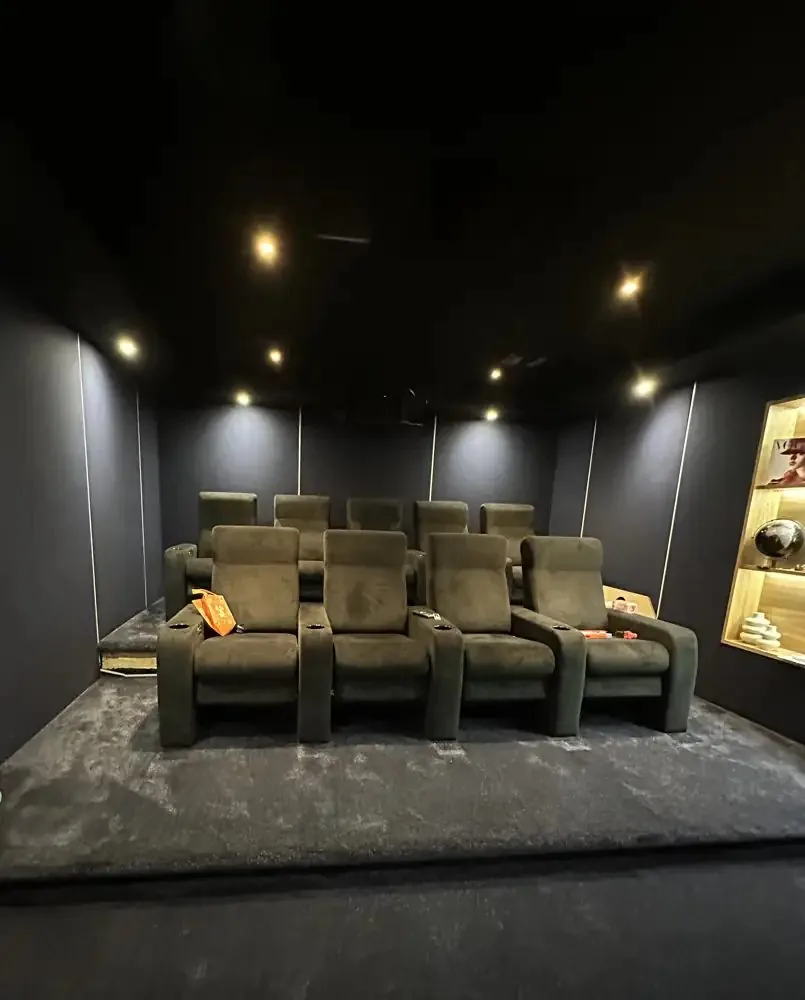 With projection, the picture is light bounced off a screen. With an LED wall, the screen is the light source: millions of tiny red, green and blue LEDs, each one controlled on its own. That one difference changes how a room can be used, how the picture looks in dark scenes and how the cinema is designed around it.
Deep black: the reason clients switch
Black is where a projector gives itself away. A projector cannot make black; it can only leave part of the screen unlit, and that part is never darker than the room around it. Any light from a lamp, a doorway or the picture bouncing off pale walls lifts the black to grey. An LED wall turns the pixels off, and the surface around the LEDs is a deep black, so a night sky looks like a night sky and the black bars of a film disappear into the wall. It is the main reason our clients choose an LED wall over a projector.
How an LED wall compares with a projector
Picture with the lights on. An LED wall keeps its contrast and colour with lamps on and daylight around the blinds. A projected image fades as the room gets brighter, which is why projection needs a dark, dedicated room.
Sound. Projection lets the left, centre and right speakers hide behind an acoustically transparent screen. An LED wall is solid, so the speakers go around it, which has to be designed from the start.
Noise and heat. There is no projector fan above your head, and passively cooled panels are silent, but a large LED wall puts real heat into the front of the room and needs its own electrical circuits.
Size and position. LED panels build out to fit the wall, with no throw distance or projector position to plan around. Projection still gives the biggest picture for the money.
Cost. LED costs more than projection for the same picture size, often by a wide margin, so it suits rooms where its strengths matter.
Is LED right for your room?
- Choose LED if the room has windows, if it doubles as a family room or bar, if you want to watch with the lights up, or if black level and HDR matter most to you.
- Choose projection if the room is a dedicated, light controlled cinema, if you want the largest possible image for the budget, or if you want the speakers behind the screen.
- If you are unsure, plan the room so either can work: we can leave the power, data and a strong, flat wall ready for LED later.
What we plan before an LED wall goes in
- Seating and pixel pitch. Cinema seats are close to the screen, so homes need a fine pitch. LED Wall Central's 2026 guidelines for luxury homes suggest 0.9 to 1.2 mm for a front row 8 to 12 feet away.
- Width for 4K. A 4K picture is 3,840 pixels across, so at 0.9375 mm it needs a wall about 3.6 m wide, and at 1.2 mm about 4.6 m. That sets the size of the room as much as the screen.
- The wall itself. It must be flat, strong and accessible for service. We agree the build up and the subframe with your builder.
- Power and heat. A large wall is a steady load. We plan dedicated circuits and ventilation with your electrician and mechanical engineer, and keep the processors in a ventilated rack away from the seats.
- Speakers and acoustics. The front speakers are placed around the wall, often within a stretched acoustic fabric wall that frames the picture.
- Calibration. A dark home cinema needs a fraction of the brightness an LED wall can give, so we calibrate it for the room, keeping the blacks deep and the picture comfortable.
- Control. One remote or touch panel runs the wall, the sound, the lights and the blinds, with Crestron or Control4 scenes for film night.
LED walls for home cinemas: the screens we install
Hisense, which approves us to install its LED walls, also makes the 136MX, a 136 inch MicroLED screen for the home that is assembled on site. Samsung has made The Wall in versions designed for luxury homes, and its all in one LED walls bring the control box and speakers into the screen. For a larger or custom shaped wall we build from modular panels. We compare the options with you before anything is ordered.
See our home cinema page, the cinema we built in Finchampstead, our home cinema installation in London page and the country home with a cinema in Beaconsfield for how we approach a full room. For businesses, see our LED video wall installation page.
Questions we are often asked
Why does an LED wall show better black than a projector?
A projector can only add light, so black is as dark as the screen in that room. An LED wall switches each pixel off for black, against a deep black surface, so dark scenes keep their depth.
Can an LED wall go in a living room with windows?
Yes, and that is where it beats projection most clearly. It holds its contrast in daylight and with the lights on, and it can be framed in joinery or covered by a motorised curtain when it is off.
What size does an LED wall need to be for 4K?
Multiply 3,840 pixels by the pitch: about 3.6 m wide at 0.9375 mm, or 4.8 m at 1.25 mm. A smaller wall at the same pitch shows a lower resolution, which can still look excellent from further back.
Where do the speakers go?
Around the wall rather than behind it, because an LED wall is not acoustically transparent. We design the speaker positions and the wall together so voices stay locked to the picture.
Do LED walls get hot or noisy?
They give off heat and need ventilation and dedicated power. Some panels use fans, so for cinemas we choose passively cooled panels where we can.
What does a design consultation cost?
A design consultation is £360 plus VAT, as listed on our booking page. We look at the room, the seating and the budget, and tell you plainly whether LED or projection suits it.
Book a consultation or call our head office on 01344 937999 (London office 0208 064 0196).